


Dana Voelker
Director, School of Sport Sciences
Professor, Sport, Exercise, and Performance Psychology
The most meaningful innovation does not always come from something entirely new or disruptive. Often, it comes from taking what you already do well and creating the conditions for it to go farther and together. In many ways, the partnership between the Biomechanics and Performance Center (BPC) and the School of Sport Sciences did not begin when the BPC opened its doors. It is a formal and intentional extension of a long-standing collaboration between our academic unit and WVU Athletics, one in which our faculty and students have been embedded for years through research, applied programming, and internship experiences. What makes this moment different is not the presence of collaboration, but the way the academic and athletic missions have been intentionally integrated into a shared vision for learning, discovery, and performance.
From the beginning, the School of Sport Sciences was not asked simply to support the BPC. We were asked to help shape it.
I remember when Coach Sabins first approached the School about the vision for the BPC. I was transparent that, at that moment, we did not yet have every structure, system, or resource fully built out. But I was confident in something more important… that we had the values, the people, and the contextual intelligence to build what was needed and to build it differently. Not as a siloed facility, but as an ecosystem.
The goal was never just to house advanced technology inside a new building. The goal was to create an environment where science, sport expertise, and education are fully integrated and where students learn with athletes, coaches, and staff, not simply about them.
The BPC provides access to advanced tools, technologies, and performance environments. The School provides the academic structure, educational design, and applied perspective that make those tools meaningful. For decades, the School of Sport Sciences has been guided by a core value that remains essential in today’s sport landscape; successful performance depends on the integration of technical expertise with deep, sport-centered knowledge. Data and technology are powerful, but only when interpreted by people who understand sport culture, coaching realities, athlete development pathways, and the human experience of performance.
For students, this partnership transforms opportunity into clearly defined pathways.
The School of Sport Sciences has developed structured residency experiences embedded within the BPC that are intentionally designed as supervised, outcomes-driven learning environments tied directly to academic credentials. Unlike traditional shadowing or observational roles, these experiences allow students to apply theory in real time, contribute meaningfully, and develop professional confidence in high-performance settings.
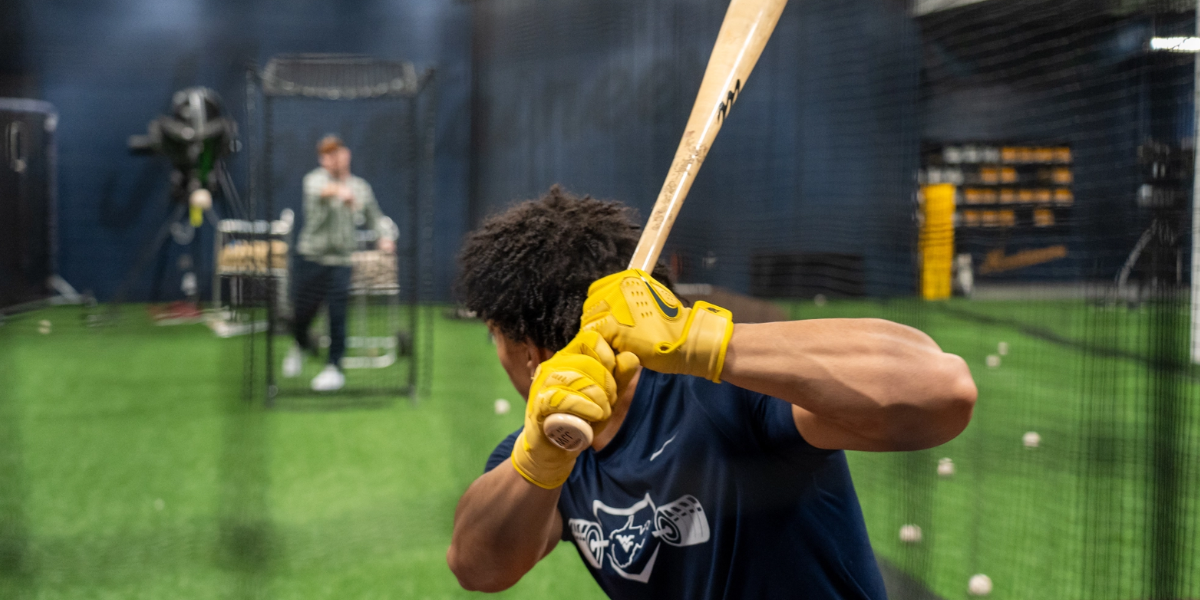
The Undergraduate Certificate in Sport Performance and Analytics prepares students for early career success through hands-on training in sport science data analysis and immersive BPC residencies, where they work directly with technologies such as TrackMan, Swing Catalyst, and iPitch in live practice environments to support individualized athlete development. The Graduate Certificate in Advanced Sport Analytics and Performance extends this experience to a systems level that prepares students to lead biomechanics and performance initiatives by integrating multiple technologies, translating data into coach-ready insights, and directing applied research projects reflective of elite sport environments. These certificates complement a comprehensive portfolio of undergraduate majors, minors, certificates, and master’s and doctoral programs across the sport sciences and other programs at WVU to create flexible, stackable pathways aligned with students’ goals and stages of development.
For athletes, coaches, and staff, the School of Sport Sciences serves as an invaluable resource. Faculty and students bring evidence-informed insight, technical skill, and intellectual curiosity. The BPC allows that expertise to be applied with greater immediacy, relevance, and athlete-centered focus to enhance decision-making while respecting the realities of competitive sport.
For the university and the future of collegiate athletics, this partnership offers a compelling model. It demonstrates how philanthropic investment, athletic vision, and academic leadership can align to create shared environments where education and performance reinforce one another rather than compete for space.
As a faculty member and school director, I see the BPC as both a beginning and a continuation. It marks the beginning of new opportunities made possible by extraordinary generosity and vision. At the same time, it represents a continuation of the values, expertise, and relationships that have long defined the WVU School of Sport Sciences.
Jointly, we have paired bold investment with deep expertise by design and then built pathways that allow students, athletes, faculty, coaches, staff, and partners to grow together.