



Courtney Semkewyc
Director, WVU Baseball Biomechanics and Performance Center
Service Assistant Professor
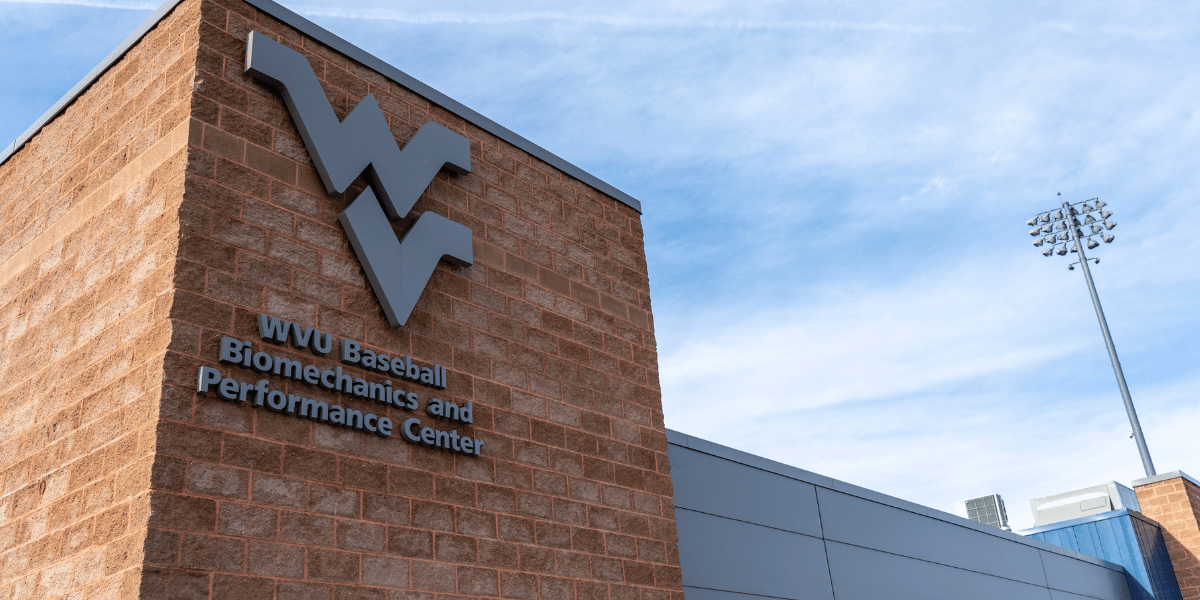
Welcome to the WVU Baseball Biomechanics and Performance Center (BPC)! The BPC is an 8,200 sq ft facility that houses some of the premier technology in baseball biomechanics and player development. Before diving into the technology, let’s start with the foundation: biomechanics. So, what is biomechanics? Sounds complicated, but it’s simply the study of how people move. It’s something that coaches do every day, analyzing how their players throw, field, or hit. The only difference is biomechanics allows us to measure it objectively. In baseball, where movements are explosive and margins for error are small, understanding biomechanics is critical. Pitchers on average are throwing harder than ever, increasing both performance ceilings and injury risk. Biomechanics allows us to analyze players individually, determining how their anatomy, mobility, strength, and mechanics influence both performance and stress on the body. To be able to get a full picture of an athlete including what can’t be seen with the naked eye, we use advanced technology. Below is an overview of how that technology supports both pitching and hitting development.
Pitching
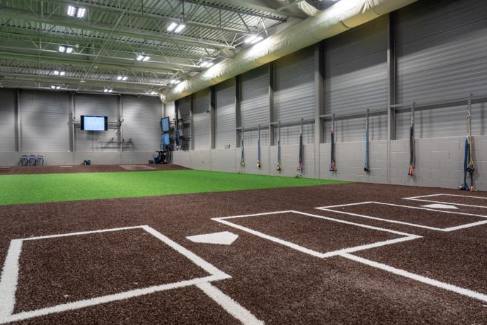
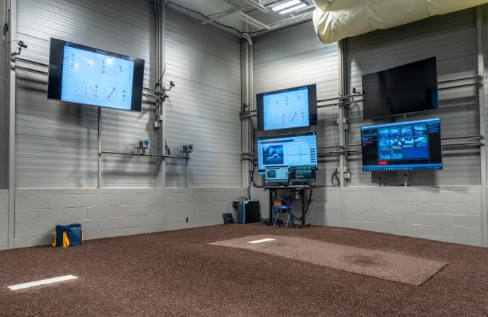
The pitching development side features a dedicated warm-up area for soft tissue work, band routines, medicine ball throws, and plyometric drills. The space includes three turf mounds, two of which are equipped with Trackman units to capture ball flight metrics used in pitch design and execution. One lane serves as the designated technology lane. In addition to Trackman, this lane is outfitted with KinaTrax markerless motion capture and a NewtForce force plate mound, allowing us to analyze both ball flight and the pitcher’s movement and force production in a single session.
Pitching technology:
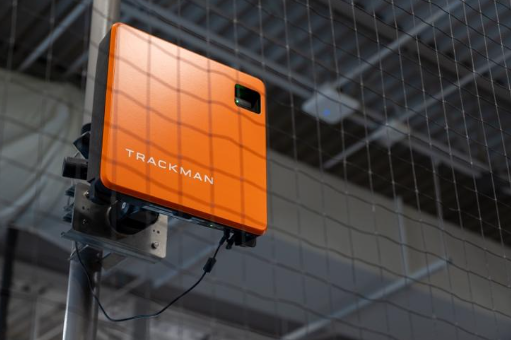
Trackman – Trackman is a radar-based ball tracking system that measures what the ball is doing from the moment it leaves the pitcher’s hand until it crosses home plate. It provides data such as velocity, vertical and horizontal movement, spin rate, spin axis (tilt), and location. Coaches use this data during pitch design sessions to refine pitch shapes, optimize movement profiles, and evaluate command and execution.
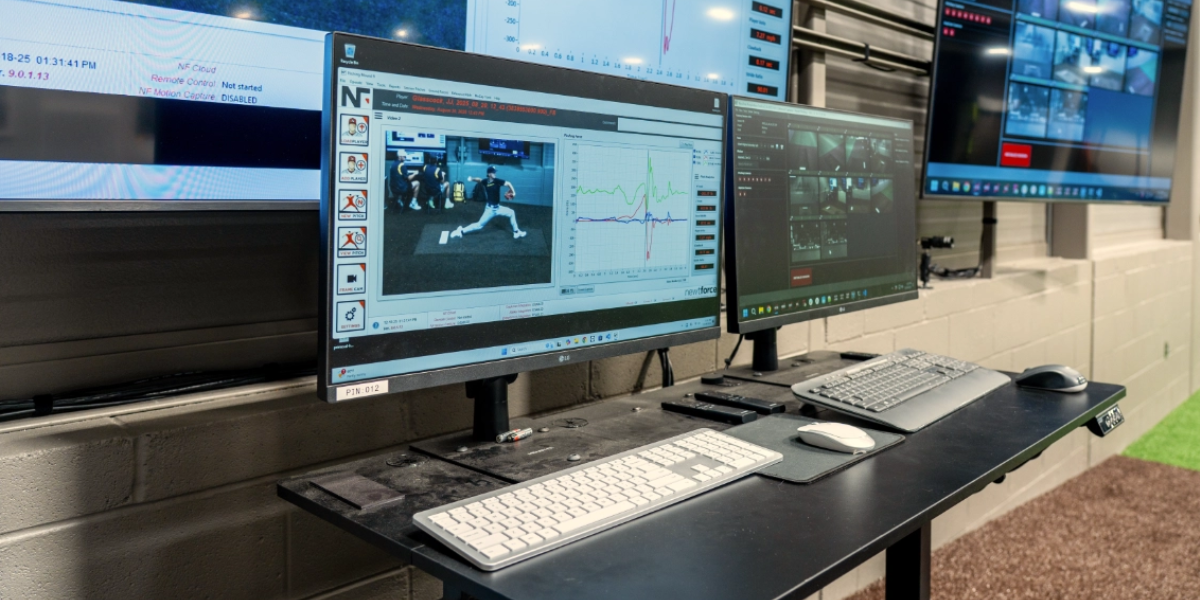
NewtForce – NewtForce is a force plate mound that measures how a pitcher interacts with the ground during their delivery. It captures ground reaction forces in three dimensions (vertical, horizontal, and lateral) as well as stride length and direction. This data helps us understand how efficiently a pitcher is producing and transferring force, which directly influences velocity, command, and overall mechanical efficiency.
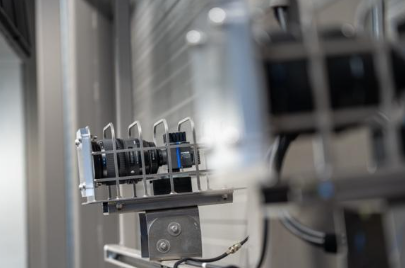
KinaTrax – KinaTrax is markerless motion capture (mocap) that uses eight cameras positioned around the mound to create a 360-degree view of a pitcher’s delivery. The system recreates the pitcher’s skeleton and tracks anatomical positions throughout the motion. Mocap allows us to analyze body positions at any point in the delivery, measure how quick they’re moving, and look at the stress placed on the arm or other joints.
Hitting
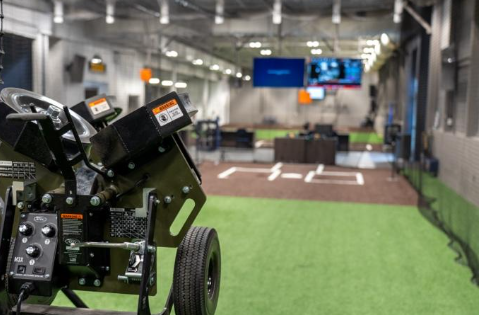
The hitting development side also features a dedicated warm-up area for soft tissue work, medicine ball drills, and movement preparation. The space includes two batting cages, both equipped with Trackman to capture ball flight metrics used to evaluate contact quality and swing decisions. Hitters also have access to a Spinball iPitch pitching machine, which can be programmed to replicate a wide variety of pitch shapes. In addition, there is a designated technology cage outfitted with Swing Catalyst force plates in each batter’s box. Beginning in April 2026, this cage will also include KinaTrax markerless motion capture, further expanding our ability to analyze swing mechanics and force production.
Hitting Technology:
Spinball iPitch Pitching Machine – The Spinball iPitch is a programmable pitching machine capable of replicating a wide variety of pitch shapes and movement profiles. This allows hitters to train against game-like pitch characteristics, improving pitch recognition, timing, and decision-making in a controlled environment.
Trackman – The same radar-based ball tracking system used on the pitching side, Trackman measures what the ball is doing immediately after it leaves the bat. It provides data such as exit velocity, launch angle, distance, spin rate, and contact location. This information allows us to objectively evaluate contact quality and better understand a hitter’s swing decisions and batted ball profile.
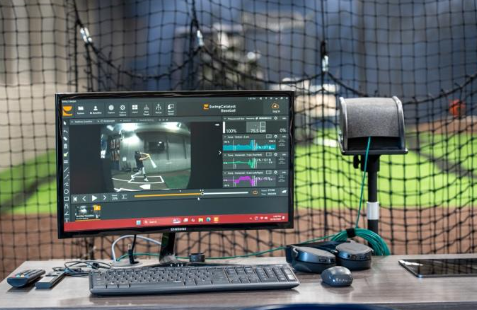
Swing Catalyst – Swing Catalyst combines force plates, pressure plates, and high-speed cameras to provide a complete picture of a hitter’s interaction with the ground and swing mechanics. The force plates measure ground reaction forces and torque production, showing how efficiently a hitter generates and transfers power. The pressure plate under the back foot reveals how weight is distributed during the swing (heel, toe, inside, outside), providing insight into balance and load patterns. High-speed cameras synchronize with the force data to analyze swing mechanics in slow motion, allowing for precise adjustments and performance optimization.
Operations and Services
The BPC has two primary functions: 1. Player development of the WVU Baseball team and 2. Promoting access to assessments for the public.
WVU Baseball:
Our team, which includes myself and over ten interns, manages data collection, analysis, and reporting for the WVU Baseball program. Each fall, players undergo an initial baseline assessment in the BPC, where we collect Trackman data and biomechanical metrics. By combining this information, we create a detailed biomechanical profile for each athlete, highlighting strengths, identifying areas for improvement, and assessing potential injury risks. We then collaborate with the coaching staff to design individualized development plans. Players are re-tested regularly to monitor progress and adjust their plans, ensuring each athlete maximizes performance while minimizing injury risk.

BioPrecision is a company that partners with the BPC to provide biomechanics assessments to the public. Their team includes former college coaches who not only conduct biomechanical evaluations but also provide personalized coaching based on the results.

Biomechanical Assessments – BioPrecision offers both pitching and hitting assessments using the advanced technology within the BPC.
- Pitching: Athletes receive detailed reports from Trackman, NewtForce, and KinaTrax, providing insight into how their body moves and how mechanics influence pitch performance and shape.
- Hitting: Assessments include Trackman and Swing Catalyst reports to show how hitters interact with the ground, generate force, and optimize swing mechanics.
All assessments include mobility and motor preference screenings, as well as a review of results with a coach to guide next steps for development. Additionally, athletes can sign up for either in-house or remote coaching as well.
For more information visit their website: https://bioprecision.com/
At the BPC, our mission is simple. Help athletes move better, perform at their highest level, and stay healthy. By combining advanced tools like Trackman, NewtForce, KinaTrax, and Swing Catalyst with expert coaching, we provide insights that go far beyond what the eye can see. Whether you’re a member of the WVU Baseball team or a player looking to take your game to the next level, the BPC offers the resources and guidance to help you reach your full potential.